MANCHESTER POWDER MILL
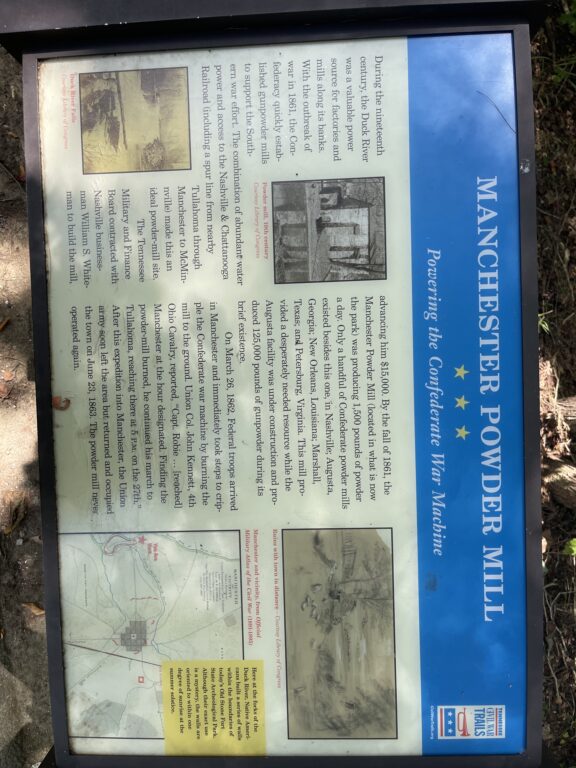
Powering the Confederate War Machine
During the nineteenth century, the Duck River was a valuable power source for factories and mills along its banks.
With the outbreak of war in 1861, the Confederacy quickly established gunpowder mills to support the Southern war effort. The combination of abundant water power and access to the Nashville & Chattanooga Railroad (including a spur line from nearby Tullahoma through Manchester to McMin-nville) made this an ideal powder-mill site.
The Tennessee Military and Finance Board contracted with Nashville businessman William S. Whiteman to build the mill, advancing him $15,000. By the fall of 1861, the Manchester Powder Mill (located in what is now the park) was producing 1,500 pounds of powder a day. Only a handful of Confederate powder mills existed besides this one, in Nashville; Augusta, Georgia; New Orleans, Louisiana; Marshall, Texas; and Petersburg, Virginia. This mill provided a desperately needed resource while the Augusta facility was under construction and produced 125,000 pounds of gunpowder during its brief existence.
On March 26, 1862, Federal troops arrived in Manchester and immediately took steps to cripple the Confederate war machine by burning the mill to the ground. Union Col. John Kennett, 4th Ohio Cavalry, reported, "Capt. Robie ... [reached] Manchester at the hour designated. Finding the powder-mill burned, he continued his march to Tullahoma, reaching there at 5 P.M. on the 27th," After this expedition into Manchester, the Union army soon left the area but returned and occupied the town on June 23, 1863. The powder mill never operated again.
Here at the forks of the Duck River, Native Americans built a series of walls within the boundaries of today's Old Stone Fort State Archeological Park.
Although their exact use is a mystery, the walls are oriented to within one degree of sunrise at the summer solstice.
Album: 2026-08 Huntsville Hamfest
Creation Date: August 20, 2026
Modification Date: August 25, 2026
Camera: Apple / iPhone 12 Pro Max
Lens: iPhone 12 Pro Max back triple camera 5.1mm f/1.6
Aperture: f/1.6
Focal Length: 5.1 mm
Exposure Time: 0.0015847860538827257
ISO: 32
MeteringMode: 5
Creation Date: August 20, 2026
Modification Date: August 25, 2026
Camera: Apple / iPhone 12 Pro Max
Lens: iPhone 12 Pro Max back triple camera 5.1mm f/1.6
Aperture: f/1.6
Focal Length: 5.1 mm
Exposure Time: 0.0015847860538827257
ISO: 32
MeteringMode: 5